
“Well, well, well… A man who knows a liquor hauling car when he sees one. I think I’m gonna learn to like you Murphy.”
Some premises keep recurring in pop culture because they’re an effective framework on which to hang a story of just about any kind. One that pops up time and again is Georges Arnaud’s 1950 novel The Wages of Fear, a story with an irresistible premise. Four convicts are tasked with an impossible mission, transporting volatile dynamite through the Guatemalan jungle. It’s been directly adapted masterfully by Henri-Georges Clouzot and William Friedkin, and there’s even a 2024 Netflix miniseries adaptation.
While not directly adapting the story, the new film The Weight borrows the engine of desperate men in a desperate situation tasked with an impossible mission. A series of title cards inform us that we’re in Eugene, Oregon and it’s “1933, Four Years into the Great Depression,” and we meet WWI veteran Samuel Murphy (Ethan Hawke) an unemployed widower attempting to shield his young daughter Penny (Avy Berry) from the world. An adept mechanic and accomplished reckless driver, Murphy can’t seem to catch a break in these hard times, finding him and his daughter kicked out of their apartment.
Watching a father struggle his way through the Great Depression with his spitfire young daughter may call to mind the great Paper Moon, but this film makes a dramatic swerve away from that in just ten minutes. After attempting to protect Penny from a group of men who turn out to be cops, Murphy is arrested and Penny placed in a group home. Four months later, Murphy is working with a group of convicts in a labor camp, blasting through a mountain to create roads.
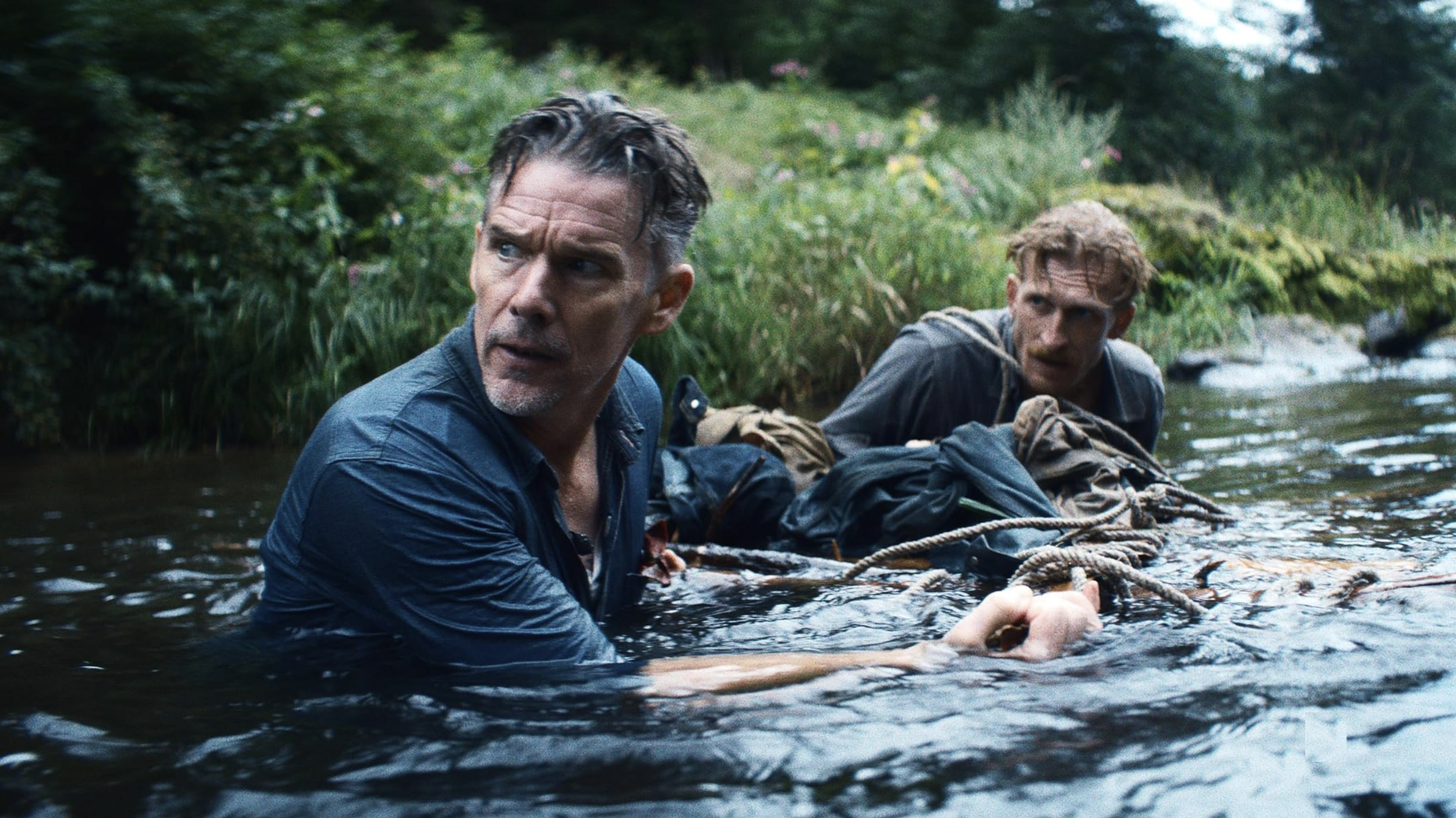
When he proves himself a problem solver to warden J.J. Clancy (Russell Crowe), Murphy is enlisted by the man in charge for a unique project with the promise that he will sign the papers to free him and prevent his daughter from becoming a ward of the state. Clancy and a man at a local mine named Taggert (Alec Newman) have a plan to abscond with a whole bunch of gold and the only thing standing between them and an untold fortune is a hundred miles of Oregon wilderness. Murphy and a crew made up of three other convicts, two of Taggert’s stooges, and a tracker named Anna (Julia Jones) are going to carry the gold down the mountain and all the way to freedom.
Director Padraic McKinley has worked with both Hawke and Crowe previously in his capacity as a producer on the shows The Good Lord Bird and The Loudest Voice, respectively, and it’s easy to see why he’d gravitate toward these two actors for this film. This is a film that could have easily been made in the 1950s with Kirk Douglas and Robert Mitchum in place of Hawke and Crowe, and that likely appealed to their sensibilities as actors. Crowe, as ever, likes to put a little extra ham on the sandwich, but that makes him a welcome counterbalance to Hawke’s taciturn and completely closed off character.
That old-fashioned style suits the film incredibly well, and it’s almost difficult to think of Ethan Hawke, Gen-X’s main representative for so many decades, as an appropriate choice for a Douglas/Mitchum-esque anti-hero. However, his strong moral center and authenticity as an actor give his character’s morally ambiguous actions appropriate weight, still allowing you to root for him despite the things you’ve seen him do. Hawke was never as chameleonic an actor as he is of late. From his exuberant Oscar-nominated turn in Blue Moon to his work in Almodovar’s Strange Way of Life, plus those stupid Black Phone movies, along with all of the interesting stuff he’s doing on television, he’s never been better as an actor than he is right now.
The cinematography by Matteo Cocco is lush and beautiful and shows off the natural beauty and horror of the landscape incredibly well. There is an incredibly well staged sequence late in the film set during a thunderstorm with infrequent bolts of lightning providing the only light. Some questionably staged fight scenes, including one partially underwater and another not long after the aforementioned thunderstorm scene, are shot in a way where it is borderline impossible to discern what’s happening.
The script does a good job of doling out character backstories, getting to know the men (and woman) little by little, as none of them really know one another. Whom can they trust? Is anyone on the level? Do these convicts really think that Clancy is going to sign those papers after all of the illegal and illicit things they’ve seen? The tenuous partnerships these men forge are just that, flimsy and without depth, which will inevitably lead them to question whatever trust they put in one another.
This is where the main difference between The Weight and films like The Wages of Fear and Sorcerer is revealed. This is a much more commercial, much more crowd-pleasing film. Dare I say, it’s almost the feel-good version of those films, where the audience leaves with a satisfied spring in their step from the anachronistic final needle drop. There’s absolutely nothing wrong with that, I don’t say that as a judgment on any of those films, it just helps the film avoid becoming a bummer—which is inherent in any adaptation of The Wages of Fear.
I know the term “dad movie” has become something of a pejorative in this day and age, but this is what the kids might call an S-tier dad movie. It’s a pretty good movie with a couple of sins your average dad is willing to forgive because there’s real deal men doing man stuff in this movie, protecting baby daughters, baseball, and a heaping helping of the kind of stuff that really gets dads going. So dads, feel free to add a full star or letter grade to any review you may read of The Weight, I can comfortably say, this one’s for you!
Header image via IMDb