
“Songs will be all they have to remember those of us who could write.”
Christopher Nolan doesn’t do small things anymore. I’d wager to say he hasn’t made a truly small movie since 2002’s Insomnia, moving away from films set mostly in one place with his fourth feature film, Batman Begins. For his thirteenth film, Nolan goes all the way back to the origins of the hero’s journey by adapting one of the oldest recorded works, The Odyssey.
Now, if you’re looking for blind and slavish fidelity to the source material, I hear the new owner of Twitter is cooking up something for you by year’s end, something you’ll really enjoy. However, if you’re looking for a colossal epic rooted in ancient storytelling traditions but also accessible to 21st century audiences, Nolan’s The Odyssey is about as good as it gets. Nolan has a way of humanizing protagonists who seem to have lost their humanity, particularly when he’s adapting established works. He also has a habit of infusing his characters with some of his own autobiography, but we’ll get back to that point later.
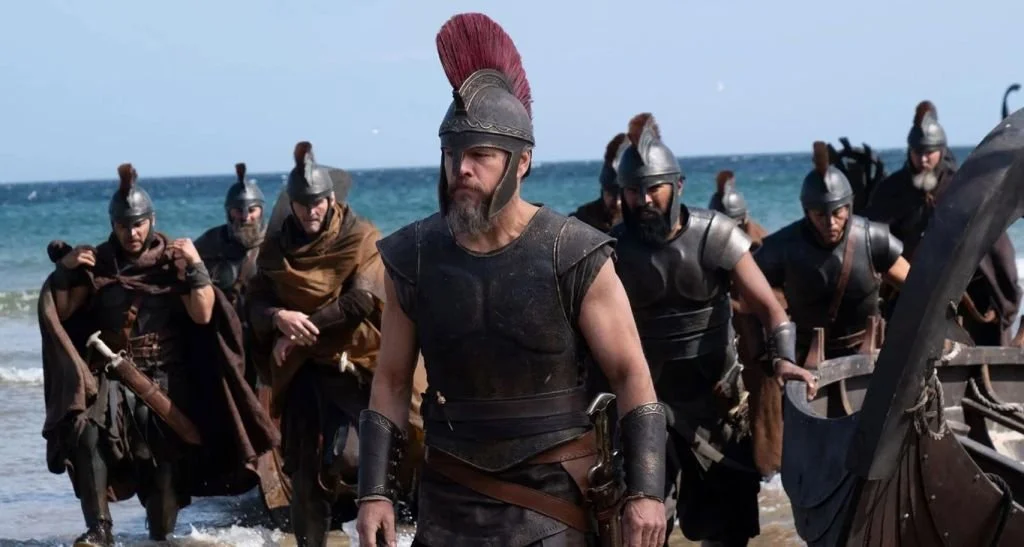
If you went to one of these cretinous American high schools that somehow skipped over The Iliad and The Odyssey, the latter was sort of the first sequel, set after The Iliad’s coverage of the Trojan War—though Nolan sprinkles bits and bobs of that tale into his. After ten years away from his kingdom of Ithaca, Odysseus (Matt Damon) has successfully helped Agamemnon (Benny Safdie) lay siege to Troy with his legendary Trojan Horse maneuver. Odysseus and his men set sail for home, though they have yet to reach it nearly a decade later.
Back home in Ithaca, however, it’s going on twenty years since Odysseus left, and his wife Penelope (Anne Hathaway) and son Telemachus (Tom Holland) are desperately fending off a gaggle of suitors who have come from far and wide to claim Odysseus’ throne. Desperate to learn more about the father he no longer remembers, Telemachus sails to Sparta to speak with Menelaus (Jon Bernthal), who fought alongside Odysseus, but arrived back in his home years earlier, hoping he may hold the key to his father’s actual whereabouts. Also, briefly, I think Bernthal is the most direct thing I can point to in acknowledging the influence of Martin Scorsese’s The Last Temptation of Christ on this film—which Nolan has cited as an influence.
Meanwhile, unbeknownst to anyone, Odysseus is on an island living with his cool new wife Calypso (Charlize Theron), just the two of them, fishing and eating lotus flowers. Odysseus has vague memories of leading his men on many adventures, encounters with the one-eyed goliath Polyphemus (Bill Irwin), the enormous (though decidedly not cannibalistic) Laestrygonians, and many other fantastical things; The film opens with the phrase “A time of apparent magic” on screen, almost always giving credence to the idea that there was no divine intervention and the fantastical elements could have potentially been wild exaggerations or outright fabrications.
This is Nolan’s stock in trade, grounding things in as much “reality” as possible. This doesn’t mean that he’s looking to be one hundred percent dead on balls accurate in his methodology, he’s working slightly closer to the realm of The Human Centipede‘s claim that it is 100% medically accurate. He tries to ground things in as much reality as possible so that when the impossible begins to occur, you’ll buy it as part and parcel with the world Nolan has created. He’s not the second coming of Stanley Kubrick, much as film nerds online might want him to be, he’s not quite that analytical about it all and is clearly a much more nakedly emotional filmmaker.
Nolan continues working with his new team of technical collaborators who all deliver outstanding, if not career best work with their contributions here. In particular, I find that editor Jennifer Lame best compliments Nolan’s conception of time and its intangible nature. There is an elegance to the way we move in and out of flashbacks, sometimes within other flashbacks themselves, and she truly helps to sell his repeated themes and moments.
Like Oppenheimer before it, The Odyssey is stacked top to bottom with incredible character actors delivering great one, two, or three scene performances. Despite his limited screen time, Elliot Page’s Sinon looms large over the film, as does John Leguizamo’s blind Eumaeus, and particuarly Samantha Morton in the film’s most bonkers sequence, which she sells the hell out of, by the way. I also found Robert Pattinson’s sniveling Antinous to be a delightful addition to the Ithaca scenes, and Lupita Nyong’o also does great work as both Helen and her twin-sister Clytemnestra, the latter of which is a beautifully portrayed nearly wordless performance. But seriously, yeoman’s work all the way around by the entire cast and crew.
Days later, Damon’s performance lingers with me, in particular the moment where he defies the gods once more by deciding to be the first man to hear the Siren’s call and live to tell the tale. It may not be the best performance of his career, but that scene and the entire final act of the film might be the best work he’s ever done on screen as both actor and movie star. He nails it in a way I honestly don’t think any other actor of his generation could have done. It is the culmination of everything we’ve ever seen from him as an actor: The tender arrogance of Will Hunting, the ever-scheming nature of Tom Ripley, the fundamental decency of Mark Watney, and the honed killer instincts of Jason Bourne. It’s all baked into the pie here and the true brilliance of his performance is that you can’t consider the entirety of it as you’re watching the film. It’s only in retrospect or a second viewing that one can fully appreciate just how remarkable a feat it is for Damon to drive the narrative, haunt the parts of the film he’s not in, and carry this entire film across the finish line.
There’s often a similar vibe between Nolan’s leading men and himself, particularly the protagonists who might be derisively referred to as wife guys like Leo in Inception or Cillian in Oppenheimer, though he was more of an other people’s wives guy. Then you’ve got a Nolan protagonist like McConaughey in Interstellar, who is bearing the guilt of being away from his family while saving the world (or, you know, making these epic movies), and Damon’s Odysseus unites these worlds of Nolan surrogates. His haggard appearance by the film’s end makes you feel the weight of the task that the character, actor, and writer/director have all accomplished.
It’s no small feat to turn the definitive hero’s journey narrative into a haunting tale of PTSD and the lingering, unresolved feelings of sacrificing so much to get so little in return. The fallout of the Trojan War is notoriously poor for all the major figures involved, most of whom don’t survive the events of The Odyssey. Nolan puts the massive weight of Odysseus’ many decisions into the context of a soldier haunted by his deeds in service of what he thought to be a noble mission. It’s grand, epic, and haunting but also achingly small and relatable at the same time, a feat very few filmmakers can pull off so successfully.
I cannot say definitively that Christopher Nolan will never make a small movie again, but I don’t think he or cinema as a whole are best served by that. We need him crafting epics that make average citizens look up the best format in which to see the film, and understand the differences therein. Just the name Nolan has become shorthand for humungous spectacle best experienced in IMAX, and he is a filmmaker who has seemingly embraced that responsibility without it feeling like the ultimate act of Odysseus-like hubris. Which leads one to understand what it was that Nolan saw in the character’s journey and how to make it relatable to himself, and by extension, everyone else.
Header image via Universal Pictures