
“Get your camera out, let’s go live.”
One of the more unforgettable movies of the last decade, Boots Riley’s 2018 feature directorial debut Sorry to Bother You presented one of the strangest visions of the world ever put to film. The Chicago-born rapper proved himself a unique visual stylist with one foot firmly in the surreal, and though the film wasn’t for everyone, it established Riley as a filmmaker to watch.
His follow-up feature, I Love Boosters, turns its satirical gaze on the collision of fast fashion, stagnant wages, poor conditions for the working class, the scapegoating of shoplifters by corporations, and theft of all kinds from the intangible and intellectual to literal larceny. There’s also a slanted office building, a pyramid-scheme hocking fat-suited Don Cheadle, a soul-sucking cunnilingus demon, and a multi-purpose teleportation device straight out of Douglas Adams’ sublime satirical world. And that ain’t the half of it.
Riley’s brand of maximalism is a likely culprit for the sharp divide on his work. There is a bit more clarity and focus here than there was in Sorry to Bother You, but his maximalist instincts can often overwhelm the point he’s making. My guess is that a wide variety of people are going to say that they liked the film but felt exhausted by it—similar arguments were heard a lot during Everything Everywhere All at Once’s awards season run.
As I said, however, this film is much more focused than an initial viewing might indicate. The message of the film is simple, people everywhere around the globe just want a measure of dignity in their work and enough money to not live in poverty. However, the capitalist system seeks to constantly consolidate the world’s wealth and power to a handful of rich people who control all the levers of power. Thankfully, Boots Riley likes to live in a world where technology unifies us and contains the ability to bridge the communication gap between similarly aggrieved workers worldwide.
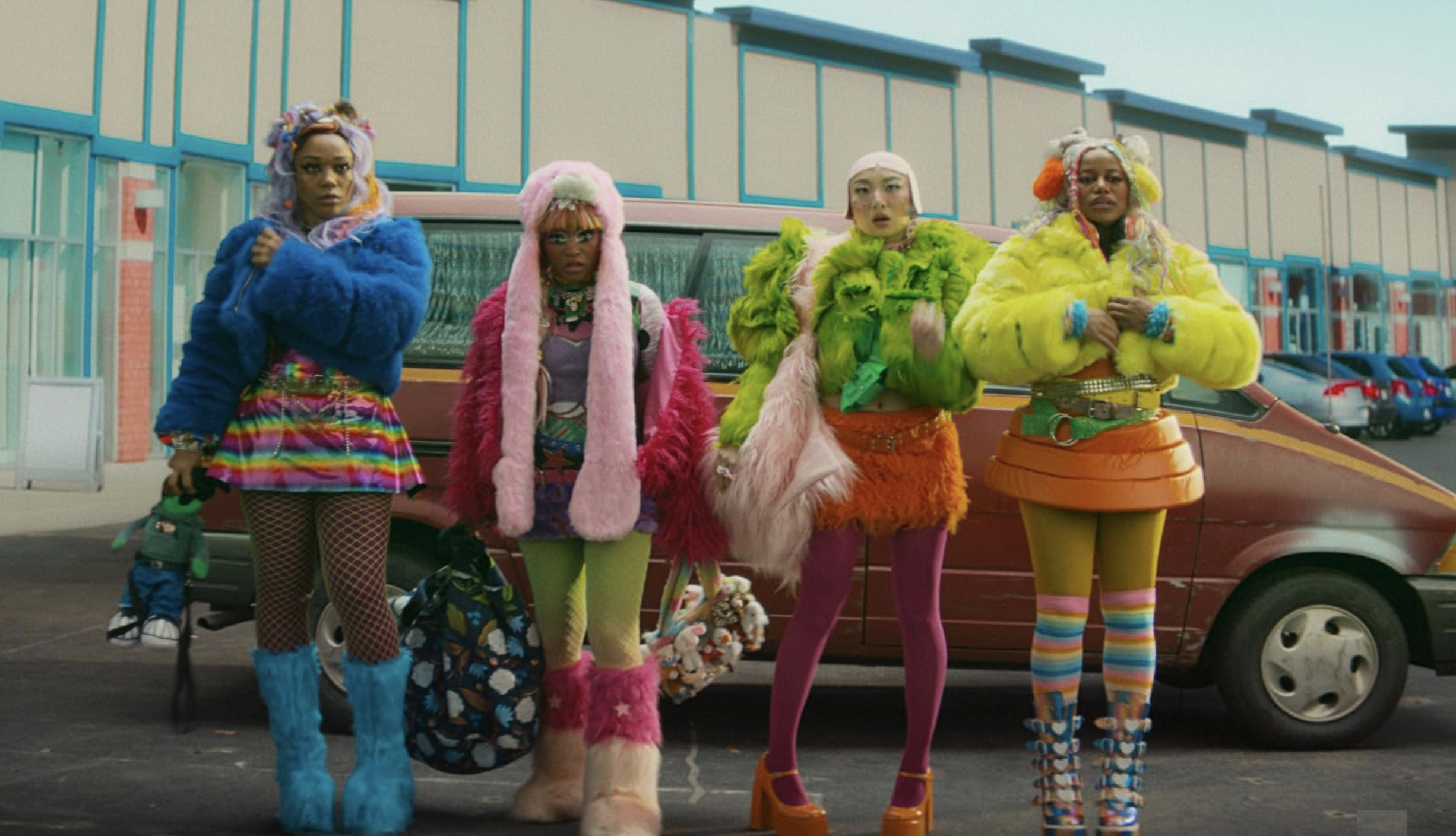
Corvette (Keke Palmer), Sade (Naomie Ackie), and Mariah (Taylour Paige) are best friends barely getting by in the Bay Area as boosters, stealing high end goods and flipping them illegally on the street. This is both a means of scraping by and an act of rebellion on their part, raging against fashion maven Christie Smith (Demi Moore) and her high-priced cheaply made clothing. Moore, in turn, has waged a media war against the trio, branding them “The Velvet Gang,” and consistently calling them "low class, urban bitches."
The ostensible leader of the operation, Corvette is currently living in a defunct fast food joint, while Sade is under the sway of the aforementioned huckster Dr. Jack (Cheadle) and his “Friends Being Friendly” scheme. Mariah, meanwhile, has a vision for a rebrand of their operation as Triple F, fashion forward philanthropy—and yes, she knows philanthropy isn’t spelled with an F.
Seeking to destroy Smith’s empire from within, the trio get jobs working at one of her impeccably color-blocked Metro Designers boutique stores, impressing their snooty manager Grayson (Will Poulter). One of their fellow employees, Violeta (a scene stealing Eiza González), is fed up with the company’s low wages and thirty-second lunch break policy, and sees potential allies in our core trio. They’re soon joined in their cause by Jianhu (Poppy Liu), a Chinese factory worker in possession of at least two teleportation devices and her own agenda and means for taking down Metro Designers for good.
And once again, we’re like maybe forty minutes into the movie at this point. There’s so, so, so, so, so much happening in this movie, it’s sometimes difficult to keep track of everything, which is particularly detrimental to the film’s climax. But keeping track of all of that stuff ultimately doesn’t matter if you’re on the film’s wavelength. I assume that all of these explanations are buried in the dialogue—the script is exceptionally clever—but I can also see the average person not being able to abide some of the stuff that happens in this film’s final half hour.
Absolutely everyone in the film is great and fits in with the tone of the movie. The peril of falling into a House of Gucci-sized mis-calibration of tone in a film like this is real, but Riley knows enough to get them all on the same page here. The core trio is just terrific, and it might be recency bias on my part having just rewatched Zola, but I really loved watching Taylour Paige, particularly a bit she has with comedian Robin Thede.
Demi Moore, coming in hot off The Substance, proves her reinvention wasn’t a fluke, and she once again proves adept with absurdist comedy. She knows the exact character she’s playing, she’s likely had to deal with these people her entire career, and she sells the genuine inauthenticity of that class so well. It’s not subtle work, but no one in this film is doing subtle work (except maybe the exceptional LaKeith Stanfield as the exceptionally named Pinky Ring Guy). The text he sends Corvette about a half an hour into the movie, coupled with his picture on the flier he then hands her, made me laugh more than anything else I’ve seen in a movie theater this year. As for his character, I’ve already alluded to him and now I’ve probably said too much about him.
The costume design by Shirley Kurata coupled with Christopher Glass’ production design, and photographed by Neon Demon cinematographer Natasha Braier is just chef’s kiss perfection. Every design element complements the tone of the film and the characters interacting with them, to a Wes Anderson-like degree of meticulousness.
That this works at all is a testament to Riley’s talent as a filmmaker. His world is an absurd heightening of our own reality, often making metaphor literal. But Riley always keeps these increasingly insane things grounded and well within the parameters of the tone he has established. For example, by the time we discover the secret of Smith’s fabled $100,000 suits, I can see a portion of the audience just giving up entirely because it makes no logical sense.
Nothing in this world makes logical sense, though, let’s be honest. Boots Riley is just doing what writers have done since the ancient Greeks, taking a very real problem and dealing with it in an absurd way so as to elucidate the true absurdity of said problem. Not everyone will go along for that ride, but I’m certainly glad to be alive in a time when Boots Riley is making these kinds of movies.
Header image via IMDb