
“I’m sorry that I broke the glass and woke you up.”
2026 will be remembered as the year that the YouTube generation beat Hollywood at their own game. In January, YouTuber Mark Fischbach’s Iron Lung opened less than a million dollars behind the big budget Send Help, and YouTuber Curry Barker’s debut film Obsession just outgrossed the new Star Wars movie at the box office. Now, 20-year old Kane Parsons has just delivered A24 their biggest ever opening with his directorial debut Backrooms, starring Oscar nominees Chiwetel Ejiofor and Renate Reinsve.
Parsons rose to fame post-pandemic with his series of YouTube shorts titled “The Backrooms,” based on an unsettling image posted to 4Chan in 2018. This film is connected to those shorts, though they’re not required viewing as Backrooms stands on its own. Ejiofor stars as Clark, a troubled man whose marriage is in ruins due to both his alcoholic and workaholic ways, and he finds himself living in the furniture store he owns sometime in the early 90s. His therapist, Dr. Mary Kline (Reinsve), encourages Clark to better himself, though Clark has resolutely decided that he is not the root cause of any of his personal problems. Kline has issues of her own, mostly revolving around a traumatic childhood spent indoors with a mentally unstable mother.
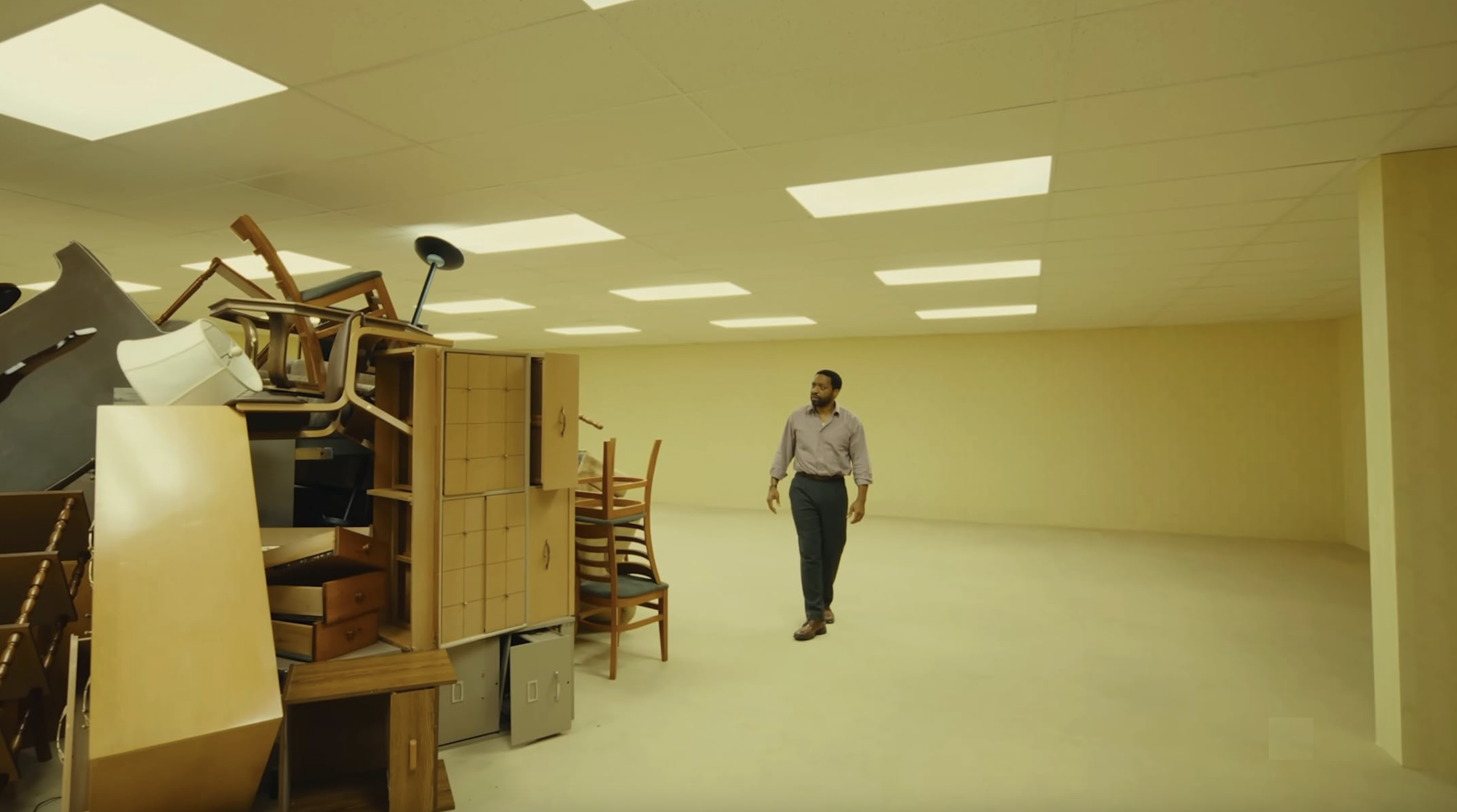
One night while sleeping at work, Clark discovers a mysterious portal to an endless series of rooms through the wall of the store’s basement. Clark then becomes consumed with mapping out the vast, fluorescent-drenched corridors and rooms contained, sharing his plans with Mary, who must venture out to find Clark when he disappears. And who is the mysterious man in a lab coat (Mark Duplass) watching from closed circuit cameras?
The film’s structure and a lot of character backstory is borrowed from Stanley Kubrick’s 1980 film version of The Shining, down to this film’s final sequence of shots. The major problem is with Will Soodik’s screenplay, which has a season one of Lost level of set-ups with no payoff in sight. There are hints and whiffs of potential answers to be found, but the film clearly wants to keep things vague enough so they can decide on an actual answer at some point down the line.
Parsons clearly has talent as a filmmaker, he’s able to sustain tension for long periods of time, utilizing the language of found footage horror to his advantage. The film’s ultimate failing is in its lack of any sort of satisfying resolution. Hedging one’s bets and leaving things open-ended in hopes of expanding the mythology in future sequels is awfully presumptuous, but the gambit clearly paid off as the film is a huge financial hit. Sequels will follow, the mythology will deepen, and perhaps this film will one day be seen as a brilliant set-up for all of that.
The glaring problem with all of this is that while they had my ten dollars and two hours worth of my attention, they failed to deliver a wholly satisfying meal. It was more like they spent all of their time crafting a really great appetizer with the a promise of another, more filling meal somewhere down the road. There are three set-pieces in the film that are outstanding, but when we get to the inevitable parlor scene—with its shades of the dinner scene from The Texas Chain Saw Massacre—expecting things to become clearer, they only become more murky. A handful of answers followed by a deluge of new questions is not a particularly satisfying way to end a film.
If you want to see a horror film currently in theaters with the courage of its convictions, willing to give a definitive conclusion at the risk of alienating some audience members, go see Obsession. I understand that it’s not a competition between the two, but Obsession plays like a film, with a beginning, a middle, and an ending. Backrooms feels more like you’re dropped into the middle chapters of a book you haven’t read, and while it can work on you in broad emotional strokes, it’s mostly just going to confuse and aggravate you.
Backrooms held my attention and kept me in its grip for a solid ninety minutes, but the final twenty unraveled in a way that was disappointing. There are hints at what might be going on in these Backrooms, but no definitive answers. That’s not disappointing in and of itself, but I got the feeling that the filmmakers didn’t know the answer to that question either. There are hints and suggestions of what it might be, and it could be any number of things, but it all remains firmly in the metaphorical.
I can’t help but marvel that this was concocted by a 20-year old, it’s a truly astonishing piece of work through that lens. However, I am more cynically left thinking about how a 20-year old is so conditioned to think that storytelling is infinite and the inter-connected multi-universal storytelling approach that has bogged down blockbusters in his lifetime is now a fundamental part of this generation’s understanding of story. “Save it for the sequel” is a given in this day and age, unless it’s a catastrophic failure—which this most certainly is not.
I turned 47 earlier this month, so I’m an old fogey nowhere near the target demographic for a horror movie like this. I can literally hear the younger generation reacting around me to what they’re seeing as I sit there trying to figure out what it all means. I would simply encourage them to enjoy the style, but demand a little more substance to go with all that style.
Header image via IMDb