
“This is god’s work, Sean. He’ll forgive us for what we have to do today.”
If the UK and Ireland seem to have a stranglehold on folk horror, it’s likely due to the subgenre’s emergence in the late 60s and early 70s with some distinctively British folk horror films like Blood on Satan’s Claw and, of course, The Wicker Man. In fact, UK and Irish filmmakers continue cranking out entries in the subgenre, with the last few years bringing us such notable films as Mark Jenkin’s Enys Men, Ben Wheatley’s In the Earth, Kate Dolan’s You Are Not My Mother, Damian McCarthy’s Oddity, and Alex Garland’s Men.
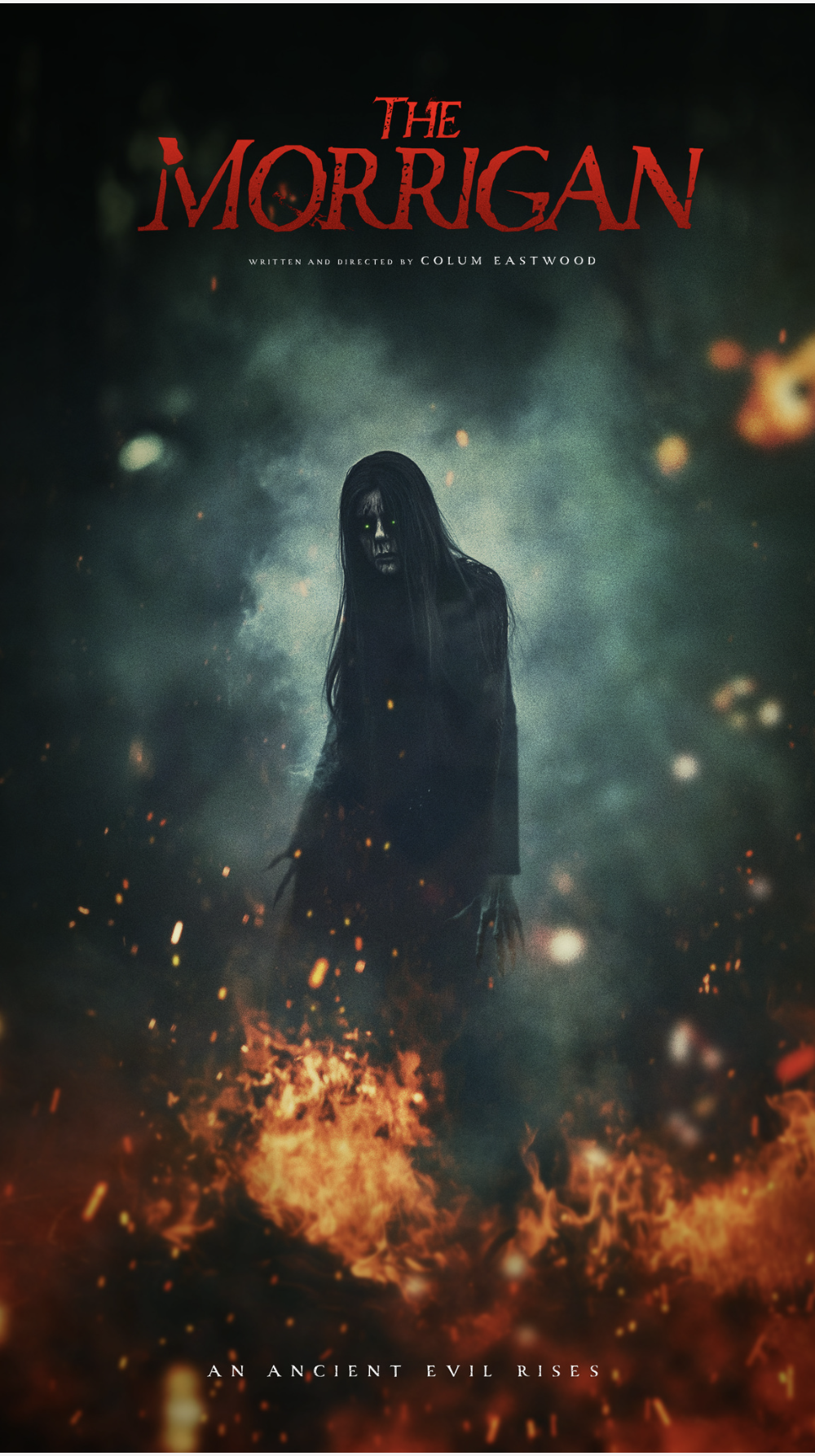
The first notable folk horror film of 2026, Colum Eastwood’s The Morrigan is an expansion of the director’s 2015 short film of the same name. The title character is a vengeful goddess from Celtic mythology, and the focus of study for archaeologist and professor Fiona Scott (Saffron Burrows), who is seeking funding for a Morrigan-related artifact finding mission in coastal Northern Ireland. Continually underestimated by her male colleagues, Fiona is granted the money provided she continues to act as second fiddle to her boss Jonathan (Jonathan Forbes) on the dig.
Arriving at the (fictional) Annan Island with her troubled teenager daughter Lily (Emily Flain) in tow, Fiona finds herself already behind the 8-ball as Jonathan and his unpaid intern Conor (Michael Shea) have already begun the dig. Their accommodations see them staying at a small inn run by Malachy (Toby Stephens) and his teenage son Sean (Art Parkinson of Kubo and the Two Strings), and with no wi-fi or cell service to keep her occupied, Lily is soon overwhelmed by the very male-dominated group and retreats to the bottom of a bottle of vodka.
However, when Fiona and company return with a casket found at the dig site, Lily finds herself called to whatever (or whomever) is inside the casket. Little do any of them realize that they’ve unleashed an ancient evil, one that predates Christianity itself, putting them in a predicament that even Malachy’s priest brother Francis (James Cosmo) is going to be hard-pressed to fight, particularly once the spirit possesses poor Lily.
My primary complaint with The Morrigan is that it is virtually impossible to see anything happening in this film. Eastwood and cinematographer Robert Binnall seem to be emulating the work that Gordon Willis did on films like The Godfather, where the density of shadows is used to brilliant storytelling effect. Unfortunately for Binnall, most people are not going to see this film projected on an enormous screen with incredible clarity, but rather on their home televisions. This might be one instance where the ignorance of the general public to settings like brightness and motion smoothing actually benefits a film, despite doing a complete disservice to the filmmakers’ intention.
A good screenplay, however, can help even the most visually uninteresting of films stay afloat. Unfortunately, Eastwood’s script for The Morrigan is a mishmash of warmed over horror clichés, most notably when cribbing more than a few of its lines from The Exorcist. The whole effort reeks of those dreaded good intentions, wherein a male filmmaker attempts to demonstrate their tacit disgust with a male-dominated society, but only succeeds in reinforcing the patriarchy. Basically, the dude set out to make a “girl power” movie and forgetting that he was supposed to be empowering his female characters rather than denigrating them.
The cast is also a mixed bag of performances that range from admirably committed like Flain, Parkinson, and Cosmo, to an almost somnambulant Burrows and most of her male contemporaries. It’s tough, because most of the performances in most folk horror films are intentionally subdued, but the tone and style of these performances doesn’t feel intentional. Basically everyone but Flain, Parkinson, and Cosmo play this like they’d rather be anywhere else on the planet than in this movie.
The Morrigan starts out promisingly enough, but like the aforementioned Alex Garland film Men, ends up undercutting its intended message by—for lack of a better term—mansplaining things to its female characters and, by extension, the audience. I’m sure Eastwood really thought he was doing something subversive with this material, but the truly progressive thing would’ve been to let a female filmmaker tell this story. Frankly, it just hits weird every single time a male character calls one of the female characters a “bitch,” and that happens several times. I get the feeling that’s a by-product of this having been written and directed by a man. That’s not the only thing wrong with The Morrigan, not by a long shot, but it is the thing I simply couldn’t move past.